Remember when advertising on TV meant buying a commercial on a local station, choosing a few programs or time slots, and hoping the right people happened to be watching?
Those days aren’t completely gone, but like most things, TV advertising has changed dramatically.
CTV advertising and OTT advertising give businesses the ability to reach consumers watching streaming TV while using many of the audience targeting and measurement capabilities associated with digital advertising.
That means a local HVAC company, law firm, healthcare organization, real estate company regional retailer or really anyone can potentially reach targeted audiences on the biggest screen in the house, without approaching TV advertising the way brands did previously.
If you’ve heard of Connected TV (CTV) and Over-the-Top (OTT) advertising aren’t entirely sure what they mean or whether there’s even a difference between them, you’re not alone.
Let’s break it down.
CTV vs. OTT Advertising: What’s the Difference?
The terms CTV and OTT are often used interchangeably, but technically, they’re different.
OTT stands for Over-the-Top. OTT refers to video content delivered over the internet rather than through a traditional cable or satellite television provider.
Think streaming.
CTV stands for Connected TV. CTV refers to internet-connected televisions and devices used to watch streaming content on the biggest screen in the home.
That could include a smart TV or a television connected through a streaming device or gaming console.
Here’s the easiest way to remember it:
OTT is how the content gets there. CTV is where you’re watching it.
If you’re watching an ad-supported streaming service through your smart TV, you’re consuming OTT content on a CTV.
Simple enough. Of course, the advertising industry has found approximately 4,000 ways to make it sound more complicated.
Where Do CTV Ads Appear? Popular CTV & Streaming TV Platforms
This is where things get more interesting for marketers.
The streaming ecosystem now includes a huge collection of ad-supported platforms and viewing environments.
Depending on how a campaign is purchased and the inventory available, advertising opportunities can include streaming environments associated with services such as:
- Hulu
- Netflix
- Disney+
- Peacock
- Paramount+
- The Roku Channel
- Tubi
- Pluto TV
- YouTube TV
- Sling TV
- Live streaming television
On the platforms that Bad Rhino works CTV into our advertising strategies, we’ve had access to place ads on over 500 streaming channels
There’s also an important distinction between where an ad appears and where an advertiser buys that ad.
Advertisers may purchase inventory directly from certain streaming platforms, through advertising technology companies, or programmatically through platforms that provide access to inventory across multiple publishers.
In other words, advertisers don’t necessarily need separate advertising relationships with every streaming service where they want their ads to appear.
Modern programmatic CTV advertising can provide access to streaming inventory across numerous publishers through a single campaign or advertising platform.
That can make the CTV ecosystem considerably more accessible to advertisers than traditional television buying.
CTV Isn’t Just Traditional TV Delivered Through the Internet
At first glance, a CTV ad looks pretty familiar.
You’re watching a show. The show pauses. A commercial plays.
But what’s happening behind the scenes can be significantly different from traditional television advertising.
Traditional TV advertising has historically been purchased largely around programming, geography and estimated audience demographics.
CTV advertising can introduce considerably more audience targeting and measurement.
Instead of simply choosing a television program or time slot, advertisers may be able to focus campaigns around the characteristics of the people and households they actually want to reach.
That’s where CTV advertising starts behaving much more like digital advertising.
How Does CTV Advertising Target Audiences?
Depending on the CTV advertising provider, available data and campaign, advertisers may be able to build audiences using factors such as:
- Geography
- Demographics
- Interests
- Consumer behaviors
- Purchase intent
- Household characteristics
- First-party customer data
- CRM audiences
- Website visitors & Retargeting Data
Think about the difference this way:
Traditional TV might say: “We want to reach adults 35–54 watching the 6:00 news.”
A targeted CTV campaign could potentially say: “We want to reach homeowners within our service area who match the characteristics of our ideal customer.”
That’s a very different advertising strategy.
Instead of buying access to a particular television program and assuming the right people are watching, CTV targeting can help businesses build an audience first and then reach that audience across available streaming inventory.
Can Local Businesses Advertise on CTV?
Absolutely. And that’s one of the biggest misconceptions surrounding streaming TV advertising.
TV advertising has traditionally felt like something reserved for major national brands with enormous advertising budgets.
CTV has changed that equation. A regional HVAC company doesn’t necessarily need to advertise to the entire Philadelphia television market.
A real estate company doesn’t necessarily need to reach every household in Pennsylvania.
A healthcare organization doesn’t necessarily need everyone watching a particular television program.
Instead, campaigns can potentially focus on specific geographic markets and audience segments.
That makes CTV advertising for local businesses particularly interesting for industries such as:
- CTV for Home services
- CTV for Healthcare
- CTV for Real estate
- CTV for Law firms
- CTV for Recruiting and employment marketing
- CTV for Retail and shopping destinations
- CTV for Restaurants and hospitality
- CTV for Regional consumer brands
The ability to combine big-screen awareness with digital-style targeting opens television advertising to a much wider range of advertisers.
How Much Does CTV Advertising Cost?
There’s no universal price tag for CTV advertising.
Campaign costs can vary considerably depending on geography, audience targeting, available inventory, streaming environment, campaign objectives and how the media is purchased.
CTV advertising is commonly purchased using a CPM (cost per thousand impressions) model, meaning advertisers pay based on the number of times their ads are served rather than paying for individual clicks. If you’re just focused on a daily spend, you can expect
But the more important question for most businesses isn’t simply: “How much does CTV advertising cost?”
It’s: “How much of our overall advertising budget should we allocate to CTV?”
A local business shouldn’t necessarily pull its entire Google Ads budget to start running streaming TV commercials.
Instead, CTV should be evaluated alongside search, paid social, retargeting and other channels based on the company’s goals, audience and available media budget.
For businesses already investing consistently in digital advertising, CTV can provide an opportunity to expand reach and build awareness without abandoning the channels already generating demand and conversions.
CTV Shouldn’t Live on an Island
This may be the most important part. You shouldn’t look at CTV and think, “Let’s run some TV commercial.” View it as another potential touchpoint within the customer’s journey.
Imagine someone sees your brand while watching streaming television at night. The next morning (or while they’re watching Breaking Bad), they search for your service on Google.
Later, they’re retargeted one of your Meta ads, a customer testimonial or completed job in their own town.
They visit your website.
A few days later, they’re served another ad.
Eventually, they convert.
Which advertisement deserves the credit?
Probably not just one of them. This shows the importance on the focus on the customer journey and adding multiple touch points along the way.
CTV and the Marketing Funnel
CTV can be particularly powerful toward the top and middle of the funnel.
Awareness
Video gives your businesses an opportunity to tell a story in a way that a search ad simply can’t.
You’re getting your brand, people, product or service onto one of the biggest screens in someone’s home.
That can build familiarity before the person ever needs what you’re selling.
Consideration
Now combine that awareness with paid social, YouTube, display or other digital campaigns.
The consumer begins seeing the brand in multiple environments. Suddenly, you’re not an unfamiliar company anymore.
You’re: “Oh yeah, I’ve seen them before.”
That familiarity matters.
Intent
When the consumer eventually has a need, Google Search can help capture that existing demand.
Instead of seeing your company for the first time, they may already recognize the name.
Conversion
Paid search, retargeting, social advertising, landing pages and strong conversion experiences can help turn that awareness into an actual lead or customer.
That’s why we don’t necessarily think of CTV as a replacement for Google Ads or Meta Ads. Instead, CTV advertising is another layer that makes your entire marketing program stronger.
A Simple CTV Advertising Example

Let’s say you’re an HVAC company trying to generate more new install system leads.
You could run Google Search campaigns targeting people actively searching for:
How Is CTV Advertising Measured?
This is another major difference between traditional television and CTV advertising.
CTV advertising can offer measurement capabilities that historically weren’t available with traditional television.
Depending on the platform and campaign setup, advertisers may be able to evaluate metrics such as:
- Impressions
- Reach
- Frequency
- Video completion rates
- Website visits
- Conversions
- Household-level exposure
- Audience performance
- Geographic performance
But measurement isn’t perfect.
CTV still presents challenges around cross-device attribution, household viewing, identity, privacy and determining exactly how individual advertising exposures contribute to a conversion.
That’s another reason we don’t recommend judging CTV solely by:
“How many leads did my TV commercial generate?”
That’s often too simplistic.
CTV can influence the customer journey well before another channel ultimately captures the conversion.
How CTV Advertising Fits Into a Larger Digital Marketing Strategy
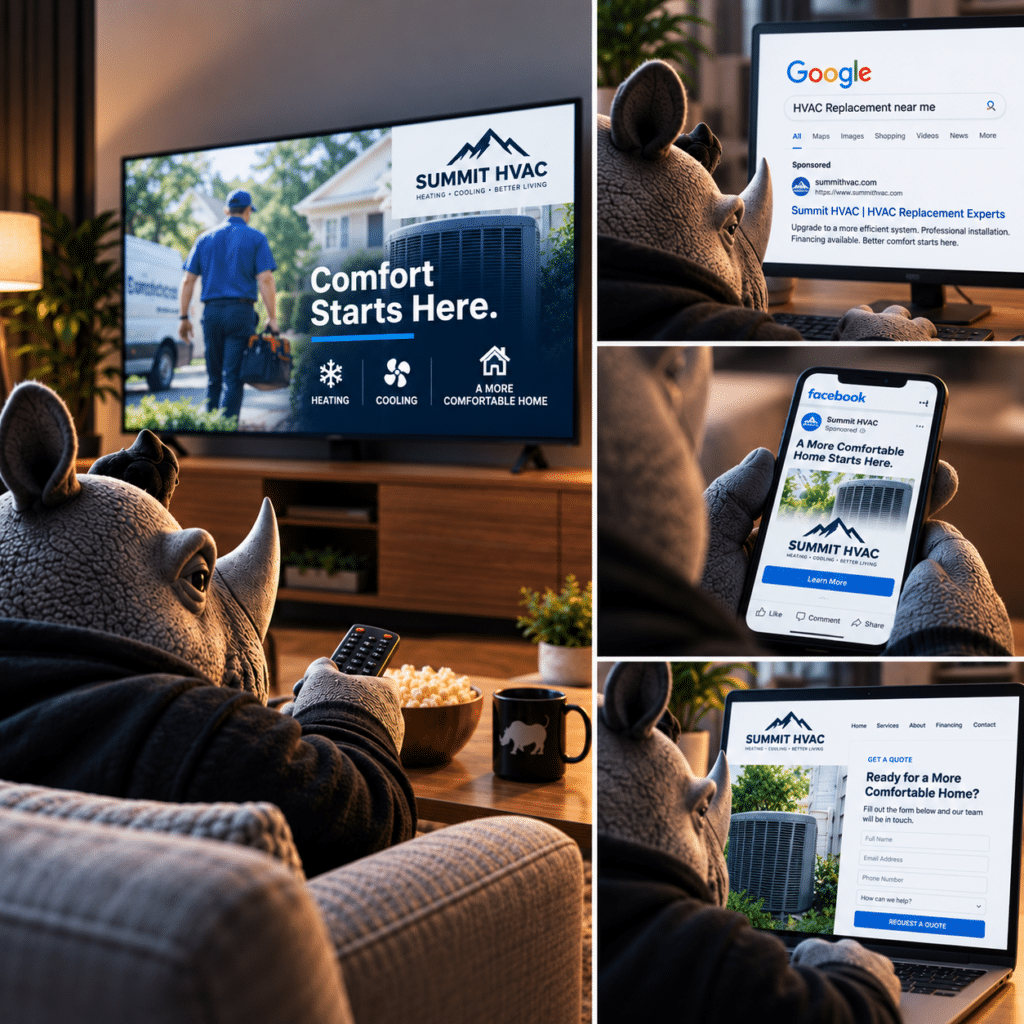
This is where CTV becomes increasingly powerful.
Think about the roles different channels can play:
- CTV Advertising creates awareness.
- Social builds familiarity and engagement.
- Google captures intent.
- Retargeting keeps your brand visible throughout the customer journey
- Content builds credibility.
- Your website converts the opportunity.
Not every business needs every channel. And throwing money at more platforms doesn’t automatically create a better marketing strategy.
The goal is to determine where your customers spend their time, how they make purchasing decisions and which combination of channels gives your brand the best opportunity to influence that journey.
That’s also why attribution can get complicated.
A consumer might first encounter your company through a CTV ad, see the brand again on Instagram, search your company on Google three days later and ultimately convert through a branded search campaign.
Google Ads may receive credit for the conversion.
But did Google create the customer or capture demand that other marketing helped create?
That’s why businesses need to look beyond last-click attribution when evaluating channels designed to create awareness.
The channels shouldn’t compete for credit. They should work together to create the customer journey.
Is CTV Advertising Right for Every Business?
No. And that’s important.
CTV shouldn’t be added to a marketing plan simply because it’s new or because streaming TV ads sounds exciting.
Businesses still need to consider:
- Their target audience
- Geography
- Available media budget
- Video creative
- Sales cycle
- Customer value
- Existing marketing channels
- Tracking capabilities
- Campaign goals
For some businesses, additional Google or Meta investment may make more sense. For others, CTV advertising may provide the incremental reach and brand awareness they’ve been missing.
And for brands already investing significantly across search and social, CTV can potentially become another powerful layer within the strategy.
Is CTV Advertising Right for Your Marketing Strategy?
Consumers didn’t stop watching television. They changed how they watch television. And advertising followed them.
CTV combines something marketers have wanted for decades: The storytelling power and impact of television with many of the targeting and measurement capabilities of digital advertising.
But at Bad Rhino, we don’t believe adding another advertising channel automatically creates a better marketing strategy. CTV makes sense when it has a defined role within the customer journey.
For some businesses, that may mean using streaming TV to introduce the brand to targeted households before they’re actively searching.
For others, it could mean expanding reach after Google and Meta campaigns have already established a strong foundation.
And for some businesses, CTV simply may not be the right investment yet.
The goal isn’t to be everywhere.
It’s to be in the right places, in front of the right audience, at the right points in their decision-making process.
That’s how we approach CTV, paid social, search, content and digital advertising at Bad Rhino, as pieces of one larger marketing strategy.
Because reaching someone once is advertising. Building familiarity across the places they spend their time? That’s a marketing strategy.
Want some help tackling your CTV Advertising Strategy? Contact Bad Rhino now!
CTV & OTT Advertising FAQs
Question: What is the difference between CTV and OTT advertising?
Answer: OTT refers to video content delivered over the internet rather than through traditional cable or satellite. CTV refers to the internet-connected television or device used to watch that content.
Question: What is CTV advertising?
Answer: Connected TV advertising allows businesses to serve video ads to audiences watching streaming content on smart TVs and other internet-connected television devices. It combines the big-screen experience of traditional TV advertising with many of the targeting and measurement capabilities associated with digital advertising.
Question: Can local businesses use CTV advertising?
Answer: Yes. CTV advertising isn’t limited to national brands. Local and regional businesses can use geographic and audience targeting to reach consumers within specific markets or service areas. That can make CTV particularly interesting for businesses in industries such as home services, healthcare, real estate, legal services, automotive, retail and education.
Question: How much does CTV advertising cost?
Answer: CTV advertising costs vary based on factors including audience, geography, inventory, targeting, platform and campaign objectives. Rather than evaluating CTV based on a universal minimum budget, businesses should determine how streaming TV fits within their overall media mix and available advertising budget.
Question: Can you target specific audiences with CTV advertising?
Yes. Depending on the advertising platform and available data, CTV campaigns may use targeting based on factors such as geography, demographics, interests, consumer behaviors, household characteristics and first-party audience data.
Question: How does CTV advertising fit with Google Ads and social media advertising?
Answer: CTV can help generate awareness and familiarity before someone actively searches for a product or service.
Google Ads can then help capture high-intent searches, while Meta and other social advertising can reinforce the message, expand reach and retarget audiences.
Together, the channels can influence different stages of the customer journey.