I’m sure there was a time when you ran a Facebook ad, received a bunch of leads, and wondered why you weren’t doing it sooner. But now the same campaign seems to cost more and fewer people are clicking. Leads and/or sales aren’t coming in like they used to. And the leads you are getting aren’t always the right ones. If your Facebook ads aren’t working, your’e not alone.
So what happened?
Facebook ads aren’t necessarily broken. But the way businesses need to approach Facebook advertising has changed.
If your Meta ads aren’t performing like they used to, here are some of the most common reasons why.
1. Your Creative Has Gone Stale
This is one of the first things we’d look at.
If you’ve been running the same image, video, headline and offer for months, there’s a good chance your audience has seen it before. Even if they haven’t consciously noticed your ad, they’ve probably scrolled past it enough times that it no longer grabs their attention.
And that’s a problem.
People don’t stop scrolling because they see an ad. They stop because something about the ad gives them a reason to pay attention.
That could be:
- A strong headline
- An interesting image or video
- A problem they immediately recognize
- A compelling offer
- A question that makes them curious
- Something that feels relevant to them
If your Facebook ads aren’t working, don’t immediately assume you need a bigger budget.
You may just need to rework your creatives.
And “better” doesn’t necessarily mean more polished. Sometimes a simple, authentic piece of creative can outperform something that looks like it came straight from a corporate advertising department.
2. You’re Relying Too Much on Targeting
For years, one of the biggest conversations around Facebook advertising was targeting.
Who should we target? What interests should we use? What age range? What behaviors? What audience should we exclude?
Those questions still matter, but advertisers shouldn’t assume targeting alone will make an ad successful.
Your creative needs to help identify the right person, too.
If you’re a personal injury attorney, for example, an ad that simply says, “Contact Our Law Firm Today”, doesn’t give someone much reason to stop. Compare that with something that immediately speaks to a specific problem or situation.
The second approach gives the person a reason to think:
“That’s me.”
Your audience isn’t just defined by the settings inside Meta Ads Manager. It’s also defined by what your ad says and shows.
3. You’re Optimizing for Clicks Instead of Customers
Here’s a mistake we see all the time when people say Facebook ads aren’t working: The ad gets clicks, so it must be working.
Not necessarily. Clicks are only one step in the process.
A campaign can generate plenty of traffic and still produce very few qualified leads. It can generate leads that don’t answer the phone. It can generate leads that aren’t actually interested in your service. And it can generate leads that will never become customers.
That’s why businesses need to look beyond surface-level metrics.
Instead of only asking:
“How many people clicked?”
ask:
- How many people became leads?
- How many leads were qualified?
- How many appointments were booked?
- How many opportunities reached our sales team?
- How many became customers?
- What did those customers ultimately cost us to acquire?
The right KPI depends on your business and campaign objective, but the basic idea is the same: A cheap click isn’t necessarily a valuable click.
4. Your Offer Isn’t Giving People a Reason to Act
Sometimes the problem is simply your offer. If your ads asking your audience to take action with a “Learn about our services” CTA, why would anyone jump for that? Instead, stronger offers like “Get a Free ______”, “Claim your Free 30-Minute Consultation”, or “Try Your First Class Free” all encourage action.
The right offer depends entirely on the business. Your ad doesn’t have to give away something for free. It does, however, need to communicate why taking action is worth someone’s time. Start with your offer if you feel like your Facebook ads aren’t working anymore.
5. Your Landing Page Is Killing Your Ad
When traffic makes it to your landing page, is it going to a destination that takes forever to load? Does your landing page expalin teh offer clearly? Is the information easy to digest?
Answer all of those questions and be sure you’re not losing the leads at this step, before they have a chance to convert.
Your Facebook ad and landing page should feel like they belong together.
If the ad says: “Get Your Free Consultation”, the landing page should make it immediately clear how to get that consultation.
Don’t make people work for it. And don’t assume a great ad can overcome a poor conversion experience. Your ad gets the click. Your landing page has to earn the conversion.
6. You’re Not Testing Enough
One of the biggest mistakes businesses make with Facebook advertising is treating an ad like a finished product.They create one ad, launch it and wait.
But good advertising is a process of testing and learning.
You might test:
- Different headlines
- Different images
- Video vs. static creative
- Different offers
- Different calls to action
- Different landing pages
- Different messaging
The key is to actually learn from the tests. If you change five things at once, it becomes much harder to understand what caused the performance difference.
Meta’s own guidance around testing emphasizes isolating variables so advertisers can determine what actually changes performance. The goal isn’t to create 50 versions of an ad just because you can. The goal is to continually learn what makes your audience respond.
This is one area to focus on if your Facebook ads aren’t working.
7. Your Facebook Ad Strategy Hasn’t Changed In Years
The campaign that worked two years ago may not work today. Your competitors may be advertising differently. Your customers may have different expectations. Your offer may have changed. Your creative may have become less effective. Your website may have changed. Your sales process may have changed.
And Meta itself continues to evolve its advertising environment and formats.
That means your strategy can’t be what worked forever ago. It needs to evolve along with the platform and the changing needs of your audience.
So, Are Facebook Ads Dead?
No, but “set it and forget it” advertising is, and always will be a problem. If your Facebook ads aren’t working anymore, the answer isn’t automatically to increase your budget.
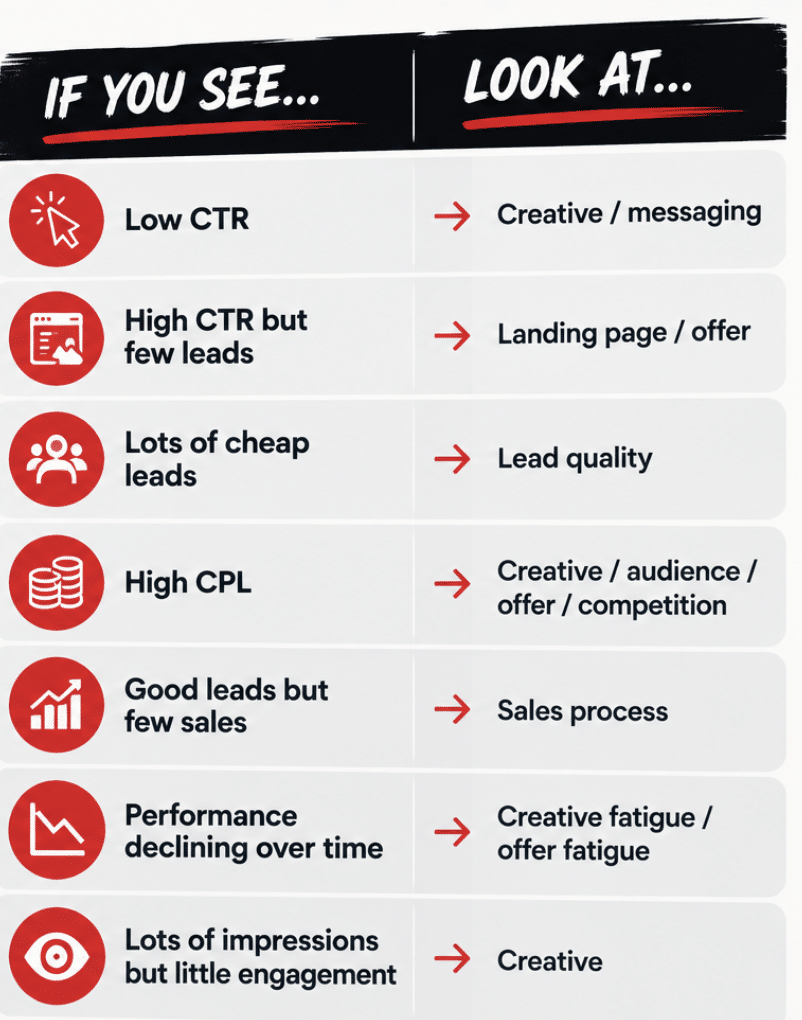
Start by looking at the entire customer journey:
Creative → Audience → Offer → Click → Landing Page → Lead → Customer
Where is the breakdown happening? That’s the question worth answering.
Because sometimes the problem is your ad. Sometimes it’s your offer. Sometimes it’s your landing page. Sometimes you’re generating leads that aren’t actually valuable. And sometimes the strategy simply needs to evolve.
The Bottom Line
Facebook and Instagram can still be powerful channels for reaching potential customers, but successful advertising requires more than putting money behind a post and hoping for leads.
You need the right message, the right offer, the right creative, a conversion path that makes sense, and a process for continually testing and improving the campaign.
If your Facebook ads aren’t working, don’t just spend more. Figure out what’s not working first.
That’s where a good digital marketing strategy can make the difference.
Not sure what’s going wrong with your Facebook ads? Let Bad Rhino have a look and let’s see where there’s room to improve.